If you're overwhelmed with debt, there's still hope. Our automated software will help you resolve your debt and move forward.
Median Debt Lawsuit Amount by State (2026 Study)


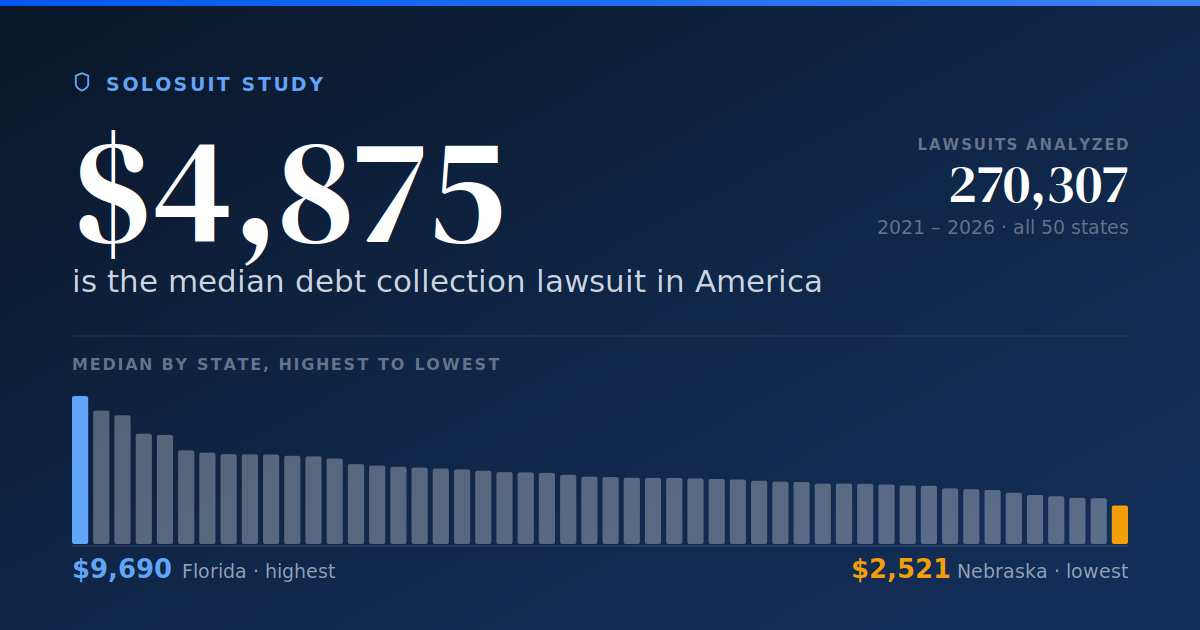
Summary: SoloSuit analyzed 270,307 debt collection lawsuits reported by our users between 2021 and July 2026. The median amount consumers are sued over is $4,875 — but it swings from $2,521 in Nebraska to $9,690 in Florida, and from $2,524 for medical debt to $11,805 for credit union debt.
The typical debt collection lawsuit in America is for $4,875. That's the median across 270,307 real cases reported to SoloSuit. The average is much higher — $9,149 — but that number is inflated by a small number of very large suits. For most people who get served, the number on the complaint falls between $2,000 and $8,000.
That's the headline. The more useful finding sits underneath it: who is suing you predicts the amount better than where you live does. A credit union sues over debts more than four times larger than a medical provider does.
If you've already been served, don't let the numbers distract you from the clock. In most states you have 14 to 30 days to file an Answer, and missing that deadline means a default judgment.
Key findings
- The median debt collection lawsuit is $4,875. The mean is $9,149 — a heavily right-skewed distribution where a minority of large cases pull the average nearly 2x above the typical case.
- Florida has the highest median in the country at $9,690 — 3.8x Nebraska's $2,521, the lowest.
- Creditor type matters more than geography. Credit unions sue over a median of $11,805; medical creditors over $2,524. That 4.7x spread is wider than the gap between the highest and lowest states.
- Amounts rose about 22% between 2022 and 2025, from $4,376 to $5,323.
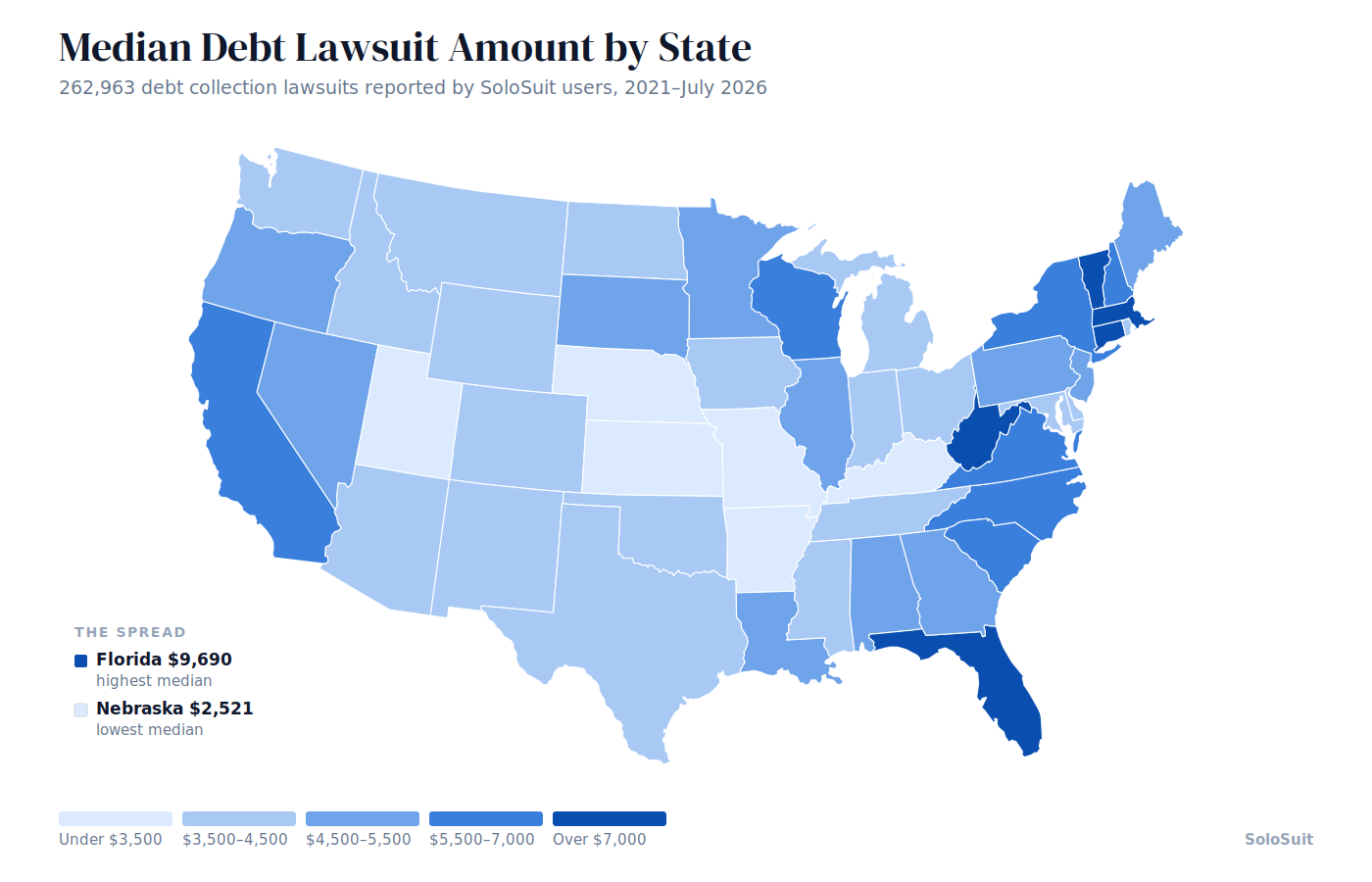
Median Debt Lawsuit Amount by State
Here is every state in our dataset, ranked by median lawsuit amount. Bars show each state's median relative to Florida's, the highest in the country. "N" is the number of lawsuits analyzed in that state.
| # | State | Median | Relative | Mean | N |
|---|---|---|---|---|---|
| 1 | FloridaTop 5 | $9,690 | $13,697 | 18,521 | |
| 2 | MassachusettsTop 5 | $8,732 | $13,013 | 3,561 | |
| 3 | West VirginiaTop 5 | $8,426 | $8,919 | 407 | |
| 4 | VermontTop 5 | $7,221 | $11,692 | 110 | |
| 5 | ConnecticutTop 5 | $7,143 | $10,448 | 1,168 | |
| 6 | California | $6,129 | $10,344 | 31,443 | |
| 7 | New York | $5,977 | $12,949 | 13,039 | |
| 8 | Wisconsin | $5,885 | $11,394 | 2,137 | |
| 9 | North Carolina | $5,875 | $9,398 | 8,753 | |
| 10 | New Hampshire | $5,858 | $11,492 | 366 | |
| 11 | Virginia | $5,774 | $13,208 | 3,124 | |
| 12 | South Carolina | $5,736 | $10,316 | 3,869 | |
| 13 | Alaska | $5,595 | $8,310 | 420 | |
| 14 | Oregon | $5,233 | $10,157 | 3,383 | |
| 15 | Louisiana | $5,131 | $8,272 | 3,626 | |
| 16 | Pennsylvania | $5,056 | $9,583 | 5,798 | |
| 17 | South Dakota | $5,000 | $10,584 | 577 | |
| 18 | Maine | $4,942 | $12,023 | 262 | |
| 19 | New Jersey | $4,884 | $9,277 | 6,595 | |
| 20 | Nevada | $4,799 | $7,981 | 4,975 | |
| 21 | Illinois | $4,711 | $9,180 | 3,556 | |
| 22 | Alabama | $4,685 | $8,689 | 4,189 | |
| 23 | Georgia | $4,656 | $8,472 | 12,122 | |
| 24 | Minnesota | $4,529 | $8,121 | 3,594 | |
| 25 | Texas | $4,404 | $8,169 | 30,904 | |
| 26 | Iowa | $4,380 | $8,304 | 955 | |
| 27 | New Mexico | $4,334 | $7,966 | 2,199 | |
| 28 | Colorado | $4,327 | $8,880 | 4,626 | |
| 29 | Arizona | $4,323 | $7,946 | 8,184 | |
| 30 | Mississippi | $4,297 | $7,225 | 2,518 | |
| 31 | Hawaii | $4,255 | $7,986 | 1,177 | |
| 32 | Maryland | $4,224 | $10,105 | 2,225 | |
| 33 | North Dakota | $4,139 | $8,671 | 601 | |
| 34 | Wyoming | $4,079 | $8,432 | 633 | |
| 35 | Washington | $4,057 | $7,484 | 8,870 | |
| 36 | Tennessee | $3,957 | $10,213 | 3,435 | |
| 37 | Oklahoma | $3,955 | $8,117 | 6,003 | |
| 38 | Idaho | $3,941 | $6,793 | 2,246 | |
| 39 | Montana | $3,893 | $6,923 | 961 | |
| 40 | Rhode Island | $3,828 | $6,985 | 1,178 | |
| 41 | Indiana | $3,811 | $7,982 | 9,273 | |
| 42 | Michigan | $3,647 | $7,008 | 8,540 | |
| 43 | Delaware | $3,588 | $7,860 | 532 | |
| 44 | Ohio | $3,534 | $6,892 | 11,851 | |
| 45 | Arkansas | $3,351 | $6,205 | 4,012 | |
| 46 | KentuckyBottom 5 | $3,210 | $7,185 | 5,979 | |
| 47 | KansasBottom 5 | $3,132 | $6,339 | 2,413 | |
| 48 | UtahBottom 5 | $3,026 | $8,207 | 3,386 | |
| 49 | MissouriBottom 5 | $3,000 | $6,795 | 2,894 | |
| 50 | NebraskaBottom 5 | $2,521 | $5,558 | 1,773 |
Why Debt Lawsuit Amounts Vary So Much by State
A $7,000 gap between Florida and Nebraska doesn't mean Floridians borrow more. Several structural forces are working at once.
How Small Claims Court Limits Affect Debt Lawsuit Amounts
Every state sets a dollar ceiling on its small claims or limited civil docket, and those ceilings differ enormously. Filing in the cheaper, faster court is attractive to collectors, so the local threshold effectively sorts cases by size. Florida raised its county court limit to $30,000 in 2020, allowing much larger claims to move through a comparatively low-friction docket.
Why Debt Collectors File More Lawsuits in Certain States
Large debt buyers concentrate filing volume in states where service of process is cheap, court fees are low, and default judgments are straightforward to obtain. High-volume, low-balance filing pulls a state's median down. Nebraska, Missouri, Kansas, Utah, and Kentucky all show that signature.
How the Statute of Limitations on Debt Changes Lawsuit Size
In a state with a short statute of limitations on debt, collectors have less time to let a balance grow with interest and fees before they lose the right to sue at all. Longer windows allow larger accrued balances to arrive in court.
Which Types of Creditors Sue Most in Each State
A state where credit unions and auto lenders are unusually active shows higher medians than one dominated by debt buyers — regardless of anything about consumer behavior there.
One number worth watching is the gap between mean and median. In Utah the mean lawsuit ($8,207) is 2.7x the median ($3,026), the widest spread in the country. That's the signature of a two-tier docket: a large volume of small-balance suits plus a thin tail of very large ones.
Median Debt Lawsuit Amount by Creditor Type
This is the finding that surprised us most.
| Creditor type | Median | Relative | Mean | N |
|---|---|---|---|---|
| Credit union | $11,805 | $16,227 | 3,915 | |
| Consumer / auto lender | $7,545 | $10,136 | 8,231 | |
| Bank / credit card issuer | $7,141 | $10,105 | 98,312 | |
| Debt buyer | $2,968 | $5,531 | 93,331 | |
| Collection agency | $2,703 | $6,055 | 8,565 | |
| Medical | $2,524 | $10,879 | 4,695 |
The spread between creditor types (4.7x) is wider than the spread between states (3.8x). If you want to predict how much you're being sued for, the name at the top of the complaint tells you more than your zip code does.
Being Sued by a Credit Union: $11,805 Median
Just 3,915 cases in a dataset of 270,000. Credit unions tend to hold secured and larger unsecured loans, they typically work with members longer before litigating, and when they do sue there's real money involved. Being sued by a credit union is uncommon, but the number attached is usually serious.
Being Sued by a Bank or Credit Card Company: $7,141 Median
At $7,141, and with 98,312 cases, banks are the largest category by volume. When a bank sues you directly rather than selling the account, it usually means the balance was large enough to justify keeping in-house.
Being Sued for Medical Debt: $2,524 Median
A median of $2,524 against a mean of $10,879 — a 4.3x gap, the widest of any category. Most medical debt suits are small: an ER copay, a lab bill, an ambulance ride. But the tail is where catastrophic uninsured hospitalizations land. If you're facing one, start with our guide on what to do when you're summoned to court for medical bills.
Are Debt Lawsuit Amounts Increasing? The 2021–2026 Trend
| Year | Median | Relative | N |
|---|---|---|---|
| 2021 | $4,501 | 19,768 | |
| 2022 | $4,376 | 33,083 | |
| 2023 | $4,605 | 58,574 | |
| 2024 | $5,290 | 48,769 | |
| 2025 | $5,323 | 61,943 | |
| 2026* | $4,693 | 48,138 |
From the 2022 low to 2025, the median rose 21.6% — $4,376 to $5,323. That tracks the post-pandemic climb in revolving credit balances and general inflation: the same underlying account carries a larger balance by the time it reaches a courtroom.
The 2026 partial-year figure comes in lower at $4,693, and we'd caution against reading a reversal into it. A partial year shifts with the seasonal mix of filers, and cases filed in the second half of the year aren't in this cut. We'll update this study at year end.
What to Do If You're Being Sued for Debt
The dollar amount on your complaint should change your strategy more than most people realize.
Being Sued for Less Than $3,000
Smaller suits tend to come from collectors that bought the account rather than the original lender. Filing an Answer alone changes the economics of the case for them. Defenses built on standing and ownership are often effective at this level, because the paperwork proving who owns the debt is frequently incomplete.
Being Sued for $5,000 to $15,000
Likely a bank, card issuer, or credit union. The plaintiff probably has full documentation, and purely procedural defenses are less likely to carry the day. This is where settlement negotiation usually produces the best outcome, and where compelling arbitration is worth evaluating if your original agreement contains a clause.
How Long Do You Have to Respond to a Debt Lawsuit?
The median case here is $4,875. A default judgment on $4,875 doesn't stay $4,875 — it accrues post-judgment interest and opens the door to wage garnishment and bank levies for years. The cost of responding is trivial next to that.
Start with your state's guide in our 50-state Answer directory, or begin your Answer with SoloSuit.
Why the Median Debt Lawsuit Amount Matters
A number like $4,875 is easy to read past. It's worth sitting with, because it describes a system working exactly as designed — just not for the person being sued.
Consider what that amount actually means. It's large enough to do real damage: a judgment accrues post-judgment interest, stays on record for years, and opens the door to wage garnishment and frozen bank accounts. But it's small enough that hiring a lawyer would cost more than the debt itself. That gap is the entire business model. Collectors file in the zone where the amount hurts enough to be worth collecting, but not enough to make fighting it look rational.
The national data shows how well that works. The Pew Charitable Trusts found that more than 70% of debt collection lawsuits end in default judgment — the defendant never responded — and that fewer than 10% of defendants who do participate have a lawyer, while nearly every plaintiff does.
Put that next to our findings and the conclusion is uncomfortable but clear: most debt lawsuits aren't decided on whether the person actually owes the money. They're decided on whether the person responded.
Three things this data should change about how you see your lawsuit
The number is probably smaller than you fear. The gap between the $9,149 average and the $4,875 median means the scary figures people hear about are outliers. Half of all debt lawsuits are for less than $4,875, and in a dozen states the typical case is under $4,000.
Who is suing tells you how strong their case is. A creditor that has held your account since day one has complete records. A collector that bought your account in a bulk portfolio may not — and it still has to prove ownership and amount before it can win on the merits. The creditor-type table above is a rough map of what you're up against.
The trend is going the wrong way. Typical lawsuit amounts climbed about 22% between 2022 and 2025. As credit card balances keep rising, the accounts arriving in court keep getting larger.
None of the variables in this study are ones you control. You can't pick your state's small claims threshold or choose who bought your debt. The one thing you do control is whether you file an Answer before your deadline — and by the numbers, that single decision separates the roughly 70% who lose automatically from everyone else.
Debt Lawsuit Amounts: Frequently Asked Questions
What is the average amount of a debt collection lawsuit?
The mean is $9,149, but the median — $4,875 — is the more useful number. The distribution is heavily right-skewed, meaning a small number of very large lawsuits pull the average well above what a typical defendant actually faces.
What is the smallest amount a debt collector will sue for?
There's no legal floor, and suits well under $1,000 do occur. In practice, collectors weigh the cost of filing against expected recovery, so very small balances are more often sold or sent to collections than litigated. See the minimum amount a collection agency will sue for.
Which state has the highest debt lawsuit amounts?
Florida, with a median of $9,690, followed by Massachusetts ($8,732), West Virginia ($8,426), Vermont ($7,221), and Connecticut ($7,143).
Which state has the lowest debt lawsuit amounts?
Nebraska, at $2,521, followed by Missouri ($3,000), Utah ($3,026), Kansas ($3,132), and Kentucky ($3,210).
Who sues over the largest debts?
Credit unions, at a median of $11,805 — more than four times the median for medical debt.
Are debt lawsuit amounts going up?
Yes. The median rose about 22% between 2022 and 2025, from $4,376 to $5,323.
Study Methodology and Limitations
Dataset
270,307 debt collection lawsuits self-reported by SoloSuit users between 2021 and July 2026, deduplicated to the most recent response per case. 262,963 include a usable state. Amounts were cleaned to a $50–$250,000 range to remove data entry errors and non-consumer outliers. States were normalized to two-letter codes. State-level figures are shown for states with at least 100 cases.
Creditor classification
Plaintiff names were classified into creditor types using keyword rules. About 80% of plaintiffs were classified with confidence; unclassified plaintiffs are excluded from the creditor-type table but remain in all other figures.
Why median rather than mean
Debt lawsuit amounts are strongly right-skewed. Reporting the mean would overstate what a typical defendant faces by roughly 88%. We report medians throughout and show means alongside them so the skew stays visible.
Limitations
These are amounts self-reported by consumers who used SoloSuit to respond to a lawsuit. The sample skews toward people who take action rather than default, and toward states where SoloSuit has a larger footprint. It is not a random sample of all debt collection lawsuits filed in the United States, and state-level counts reflect our user distribution rather than each state's true filing volume. No personal information was used: the extract contained only lawsuit amount, state, and plaintiff name.
Citing this study
Journalists, researchers, and advocacy organizations are welcome to cite these findings. Please attribute to SoloSuit with a link to this page. Suggested citation: SoloSuit, “Median Debt Lawsuit Amount by State and Creditor Type” (2026), analysis of 270,307 self-reported debt collection lawsuits. For data requests or comment, contact our press team.